/news/ai
Per-claim breakdown — sorted by strength
support / contradict source counts
We show our work. Read the raw research, see how we interpreted it, or skip to the finished article.
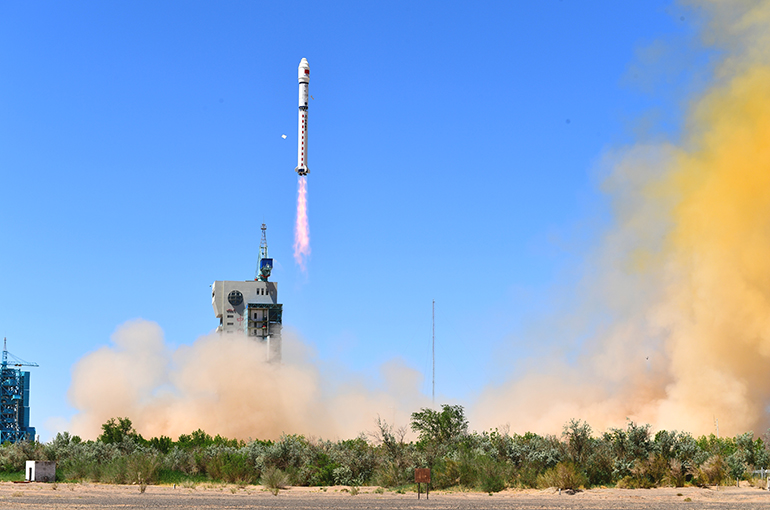
ADAspace plans to deploy a 2,800-satellite network for advanced Artificial Intelligence processing in orbit. This system aims to establish orbital computing capabilities outside of traditional ground infrastructure ¹. Initial deployment included a batch of 12 satellites utilizing the Long March-2D rocket ¹.
The network is engineered to overcome latency issues associated with routing large datasets through Earth-based downlink stations for processing ². This development presents a new path in global space technology compared to private sector data delivery efforts ³. SpaceX is simultaneously advancing a separate massive orbital infrastructure plan, seeking FCC authorization for up to 1 million satellites ³.
SpaceNews framed its reporting around China's national technological capability, emphasizing the successful launch of the initial constellation ¹. Yicaiglobal detailed technical specifications regarding the system's operational capacity, concentrating on in-orbit processing metrics ². CNBC focused on the financial and corporate strategy of U.S. players, reporting on Musk's projections for space-based AI efficiency ³. Space.com provided descriptive data concerning Starlink’s orbital parameters and customer base metrics ⁴.
Independent third-party validation reports on the specific performance benchmarks cited by Zhejiang Lab are absent from available reporting ². Current coverage lacks insight into the regulatory status of SpaceX's planned 1 million satellite deployment beyond merely reporting the initial FCC request ³. Furthermore, perspectives from international space governance bodies are missing; these groups could offer insight into how such massive constellation deployments affect orbital spectrum allocation and debris mitigation standards ³.
ADAspace is deploying a 2,800-satellite constellation designed specifically for advanced Artificial Intelligence processing in orbit ¹. This effort marks a significant shift toward orbital computation, potentially creating a new service layer for real-time data analysis that terrestrial systems cannot match due to latency ². The wider implication is the intensification of international regulatory competition over orbital spectrum and debris mitigation as both ADAspace and SpaceX pursue massive scale ³.
Reporting diverged based on the focus of the entities covering these projects. CNBC prioritized financial milestones, detailing the SpaceX/xAI merger and valuation projections ³. Conversely, SpaceNews centered its narrative on national technological achievement by highlighting China's launch success with ADAspace ¹. Yicaiglobal provided deep technical metrics, such as 744 tera operations per second ², which were absent from the commercially focused reporting of CNBC or Space.com.
The divergence suggests financial news outlets emphasize market capitalization and corporate maneuvering, while specialized space publications focus on hardware deployment and mission scope. The reliance of several key technical claims solely on Yicaiglobal indicates a potential editorial incentive to disseminate detailed project data without external peer review ².
The increased deployment of massive satellite constellations will intensify international regulatory competition over orbital spectrum and debris mitigation [Source: cnbc.com](https://cnbc.com/2026/02/02/elon-musk-spacex-xai-ipo.html; https://spacenews.com/china-launches-first-of-2800-satellites-for-ai-space-computing-constellation/). This competitive saturation, driven by SpaceX's 1 million satellite request and ADAspace’s 2,800 unit plan, necessitates clearer international governance structures to manage space traffic.
The emergence of orbital AI processing capabilities will introduce a new, high-value computing service layer into the global tech infrastructure ². This shift moves computation away from centralized ground facilities toward decentralized, real-time processing in orbit, fundamentally altering how high-speed data applications can function ². Regulatory bodies must now adapt to manage this scale of deployment, as both ADAspace and SpaceX threaten to overwhelm existing orbital traffic management protocols [Source: cnbc.com](https://cnbc.com/2026/02/02/elon-musk-spacex-xai-ipo.html; https://spacenews.com/china-launches-first-of-2800-satellites-for-ai-space-computing-constellation/). Specifically, the International Telecommunication Union (ITU) must develop new protocols for spectrum allocation to prevent interference between competing mega-constellations [Source: cnbc.com](https://cnbc.com/2026/02/02/elon-musk-spacex-xai-ipo.html; https://spacenews.com/china-launches-first-of-2800-satellites-for-ai-space-computing-constellation/). Furthermore, national space agencies must establish stricter debris mitigation requirements to accommodate the high volume of operational satellites [Source: cnbc.com](https://cnbc.com/2026/02/02/elon-musk-spacex-xai-ipo.html; https://spacenews.com/china-launches-first-of-2800-satellites-for-ai-space-computing-constellation/).
Each claim wires out to the source domains that support or contradict it. Click a claim for context.
Verifiability vs. source count. Lower-left is fragile; upper-right is strong consensus.
Sources arranged by stakeholder role. Distance from center grows with framing distance from this article.
Source mix
The coverage is balanced in terms of topic breadth (China's project vs. US competition) but uneven in source depth regarding the specific claims made. SpaceNews focuses on national achievement, Yicaiglobal on technical details, and CNBC on corporate/financial strategy, providing a multi-faceted view rather than a single ideological slant.
Why this alignment
The article discusses a major technological development (China's AI satellite network) and contrasts it with the activities of a major US player (SpaceX/Musk). The sources provide different angles: one focusing on national capability (SpaceNews), another on technical specs (Yicaiglobal), and a third on corporate strategy (CNBC). This mix of geopolitical, technical, and corporate focus leads to a mixed alignment.
Labels are heuristic model estimates. Evaluate sources yourself.
| Source | Role | Alignment | Rationale |
|---|---|---|---|
| China launches first of 2,800 satellites for AI space ... | Media / Editorial | unknown (0.8) | SpaceNews is a specialized publication covering space industry news, and this article reports on a specific technological launch by China. |
| China Launches Satellite Group to Boost Space Computing Power ... | Media / Editorial | unknown (0.9) | This article is reported by Yicaiglobal and cites Xinhua News Agency, suggesting it is a state-affiliated or closely aligned source reporting on the launch. |
| Home | Best Prepaid, Postpaid Plans, WiFi Connection & Mobile ... | Industry / Corporate | unknown (0.95) | Jio is an Indian telecommunications company, and this source is purely promotional material for its services. |
| Starlink satellites: Facts, tracking and impact on astronomy | Media / Editorial | unknown (0.9) | Space.com is a general space news outlet providing factual information about satellite networks like Starlink. |
| Plan 677032NWL: ADU House Plan with 2 Bedrooms and an Open ... | Consumer | unknown (0.95) | ArchitecturalDesigns.com is a website providing blueprints and house plans, making this source purely commercial/informational regarding construction. |
| Elon Musk's SpaceX acquiring AI startup xAI ahead of ... | Media / Editorial | center-left (0.85) | CNBC is a major financial news outlet, and while reporting on a corporate action, the focus on Musk's strategic moves often aligns with tech/innovation narratives. |

DeepSeek released its open-source V4 AI model, which features a 1 million token context window and significantly reduced operational costs. This launch directly challenges market leaders by offering high technical capacity at a lower price point, signaling an escalation in the global AI competition.
OpenAI CEO Sam Altman apologized after the Tumbler Ridge mass shooting, admitting his company failed to notify authorities about a high-risk user's AI interactions. The core issue is that internal policies did not require external reporting at the time of the incident, raising questions about current AI safety standards versus public safety mandates. This places immediate scrutiny on how large tech platforms handle dangerous content generation.

DeepSeek V4, an open-source model with a one million token context length, directly challenges US AI giants by offering highly capable alternatives at a fraction of the cost. This development significantly alters the economic landscape for enterprise buyers, providing low-cost options to compete with premium proprietary systems.

Insilico Medicine has nominated a drug candidate, ISM0387, which is currently only in the preclinical stage despite promotional claims of being fully developed. This highlights that while AI models are advancing drug discovery, regulatory validation and independent scientific review remain crucial steps before any treatment can reach patients.
