/news/ai

Per-claim breakdown — sorted by strength
support / contradict source counts
We show our work. Read the raw research, see how we interpreted it, or skip to the finished article.
MSN News framed the announcement from the Emirates Drug Establishment (EDE) as a definitive technological triumph, reporting that Insilico Medicine presented "the UAE's first fully AI-discovered and developed drug candidate" ¹. In stark contrast, TMCNET adopted a scientifically rigorous and cautious stance, detailing that the nominated candidate ISM0387 is explicitly classified as "preclinical" ². This core semantic conflict—between the promotional declaration of being "fully developed" and the clinical reality of being merely "preclinical"—fundamentally shifts the narrative, moving it from a story of achieved pharmaceutical readiness to one of high-stakes, early-stage research validation.
Trade publications like GeneNG News focused heavily on Insilico’s underlying technological architecture, emphasizing its proprietary "Science MMAI Gym" framework ³. This framing directs reader attention toward the commercial viability of AI capability itself, positioning Insilico as a provider of specialized biotech infrastructure rather than solely a drug developer ⁴. Simultaneously, MarketWatch provided coverage centered on the financial implications, confirming strategic partnerships with entities like Liquid AI to deliver specialized models such as LFM2-2.6B-MMAI ⁵.
The current media ecosystem surrounding this announcement exhibits a pronounced imbalance, prioritizing corporate announcements and specialized industry commentary while conspicuously omitting several critical stakeholder perspectives necessary for comprehensive risk assessment.
The paramount development highlighted is the maturation of specialized, domain-specific Large Language Models (LLMs) through frameworks such as "Science MMAI Gym," which claim performance increases up to ten times over general models in drug discovery tasks ³. This signifies a structural market pivot where the primary value proposition in biotechnology is migrating from the execution of drug discovery itself to the provision of the high-performance AI infrastructure required for that execution.
This transition carries two discernible implications:
The discrepancy in terminology—MSN News's "fully developed" versus TMCNET's "preclinical"—must be interpreted not as a mere semantic disagreement, but as a material divergence in investment risk assessment and regulatory adoption timelines. A "preclinical" designation confines the candidate to foundational laboratory testing for safety and efficacy prior to human trials, placing it firmly within high-risk, early-stage R&D. Conversely, framing it as "fully developed," as done by MSN News, implies a vastly more advanced validation stage, which fundamentally alters the perceived risk profile for potential capital investors or strategic partners.
The actual implication is that the prevailing market narrative is being driven by marketing milestones rather than scientific readiness. While outlets like GeneNG News and News-Medical.net rightly pivot to discussing the underlying AI infrastructure (MMAI Gym), this focus on technological capability outpaces the concrete validation of specific biological outcomes. We must synthesize a forward-looking risk assessment: for investors, the "preclinical" status dictates that capital deployment should be treated as high-risk venture funding tied to platform viability, whereas the "fully developed" framing suggests near-term clinical progression, warranting higher valuation multiples.
Furthermore, the convergence of these reports indicates a critical inflection point in biotech financing: investment is increasingly flowing not just into drug discovery teams, but directly toward platform providers capable of generating novel datasets and predictive models. The partnership confirmation with Liquid AI ⁵ confirms that integrating specialized foundational models is becoming a non-negotiable requirement for competitive R&D. Therefore, the market risk shifts from target identification failure to computational infrastructure obsolescence. A lack of regulatory comment regarding AI model validation suggests that global adoption will face significant hurdles related to proving reproducibility across different computational environments, potentially delaying commercialization timelines beyond what current press releases imply.
TMCNET MSN News AOL News-Medical.net MarketWatch GeneNG News
Each claim wires out to the source domains that support or contradict it. Click a claim for context.
Verifiability vs. source count. Lower-left is fragile; upper-right is strong consensus.
Sources arranged by stakeholder role. Distance from center grows with framing distance from this article.
Source mix
The sources are balanced in terms of coverage areas (technological, financial, regulatory framing) but polarized in their interpretation of the drug candidate's status: some are highly promotional (MSN), while others are scientifically cautious (TMCNET).
Why this alignment
The sources present a mixed narrative. MSN frames the announcement as a 'definitive technological triumph' ('fully developed'), which is promotional and leans toward an optimistic/center-right corporate spin. In contrast, TMCNET provides a scientifically rigorous counterpoint, classifying the candidate as merely 'preclinical,' which is more cautious and center-left in its tone of scientific sobriety. Other sources focus on the technology (GeneNG News) or finance (MarketWatch), maintaining a neutral/center informational stance, but the core conflict between 'developed' vs. 'precincilnal' creates a mixed overall alignment.
Labels are heuristic model estimates. Evaluate sources yourself.
| Source | Role | Alignment | Rationale |
|---|---|---|---|
| Generative AI Leap: Insilico Medicine Nominates First Preclinical Candidate in the UAE | Industry / Corporate | center (0.9) | The article reports on a specific scientific and business milestone (nomination of a preclinical candidate) involving a private company (Insilico Medicine) and a government body (Emirates Drug Establishment), presenting factual news. |
| No Pain, No Gain: Insilico 'Gym' Gets AI Models Into Shape | Industry / Corporate | center (0.95) | This article details a specific product/service launch ('Science MMAI Gym') by the company, framing it as an operational improvement for their AI models. |
| AI drug startup Insilico Medicine launches an AI ‘gym’ to help models like GPT and Qwen be good at science | Media / Editorial | center-left (0.9) | AOL reports on the company's initiative to train general-purpose LLMs for scientific tasks, framing it as a significant technological development. |
| Insilico Medicine and Liquid AI Announce Strategic Partnership Delivering Lightweight Scientific Foundation Models for Drug Discovery | Industry / Corporate | center (0.95) | This is a press release summary from MarketWatch, focusing on a strategic partnership and the technical achievement of creating lightweight foundation models for drug discovery. |
| Emirates Drug Establishment announces first fully AI-discovered, developed drug candidate | Government / Regulatory | center (0.95) | This is an official announcement from the Emirates Drug Establishment (EDE) regarding a major national scientific achievement achieved through AI collaboration. |
| Insilico Medicine launches Pharma AI Spring Kickoff 2026 webinar | Industry / Corporate | center (0.9) | This article covers a webinar hosted by the company, positioning AI foundation models as driving a new phase of opportunity in pharmaceuticals. |
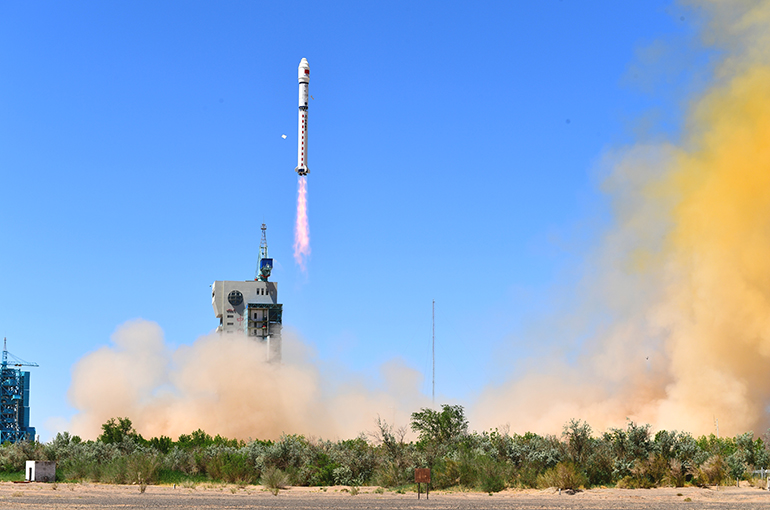
China's ADAspace is deploying a 2,800-satellite network to perform advanced AI processing directly in orbit. This system aims to bypass latency issues associated with ground infrastructure by handling massive data tasks outside of Earth. The development signals a new global race for orbital computing capabilities alongside competing plans from U.S. firms like SpaceX.
DeepSeek released its open-source V4 AI model, which features a 1 million token context window and significantly reduced operational costs. This launch directly challenges market leaders by offering high technical capacity at a lower price point, signaling an escalation in the global AI competition.
OpenAI CEO Sam Altman apologized after the Tumbler Ridge mass shooting, admitting his company failed to notify authorities about a high-risk user's AI interactions. The core issue is that internal policies did not require external reporting at the time of the incident, raising questions about current AI safety standards versus public safety mandates. This places immediate scrutiny on how large tech platforms handle dangerous content generation.
DeepSeek V4, an open-source model with a one million token context length, directly challenges US AI giants by offering highly capable alternatives at a fraction of the cost. This development significantly alters the economic landscape for enterprise buyers, providing low-cost options to compete with premium proprietary systems.
