/news/ai

Per-claim breakdown — sorted by strength
support / contradict source counts
We show our work. Read the raw research, see how we interpreted it, or skip to the finished article.
Amazon is investing up to $25 billion in Anthropic, securing access to 5 gigawatts of computing power and Amazon's Trainium chips. This massive deal indicates that the primary constraint on advanced AI development is shifting from software innovation to physical hardware scarcity. Readers should note this signals a major infrastructure arms race among tech giants.
CNBC framed the Amazon-Anthropic deal as a strategic infrastructure expansion, emphasizing an aggressive "double down" on AI capabilities ¹. In contrast, Forbes framed the event through a lens of market scarcity, suggesting compute capacity is fundamentally changing its status as an available commodity ². This divergence illustrates differing editorial priorities regarding the nature of the AI race.
The coverage lacks input from Anthropic’s executive leadership regarding strategic operational details. Available sources detail compute capacity and investment figures but omit statements from Anthropic confirming specific integration depths into AWS Bedrock ³. This absence prevents readers from determining the practical architectural dependencies of Anthropic’s models on Amazon's infrastructure beyond general access rights.
Furthermore, there is no representation from regulatory bodies overseeing large technology partnerships. The current reporting focuses exclusively on corporate financial agreements and technological capability ¹. Regulator input could address concerns regarding market concentration or whether these massive compute commitments risk stifling competition in AI model training, a perspective entirely absent from the cited excerpts.
Finally, consumer advocacy groups are unrepresented in this analysis of infrastructure investment. The narrative centers on capital expenditure and silicon access ². Consumer voices are necessary to address how these large, subsidized infrastructure deals might translate into pricing stability or accessibility for end-users of generative AI services. The absence of this perspective limits the analysis's scope regarding real-world market impact.
Amazon confirmed an expanded commitment to Anthropic with reports citing up to a $25 billion investment ¹. This agreement secures Anthropic access to up to 5 gigawatts of computing power and Amazon's Trainium chip line ⁴. This development signals a significant infrastructure arms race among major cloud providers ³. The deal underscores that the primary bottleneck for advanced AI is increasingly physical hardware scarcity and deployment timelines, not purely software innovation ².
Amazon is committing up to $25 billion in new investment to Anthropic ¹. The deal requires an immediate $5 billion payment, with remaining funding contingent on future commercial milestones ¹. Anthropic gained access to up to 5 gigawatts of computing power through the partnership ⁴. The agreement grants Anthropic access to Amazon’s Trainium chip line, including future generations ¹. Forbes characterized the situation as a fundamental shift where "compute stops being a commodity" ². Forbes cited the total potential investment, including prior commitments, at approximately $33 billion ². Anthropic is distributing its Claude AI model across multiple cloud platforms, including AWS Bedrock and Microsoft Azure Foundry ³.
The reporting diverges based on whether outlets prioritize financial transaction size or underlying technological constraints. CNBC focuses its coverage on Amazon’s direct, immediate capital commitment ¹. In contrast, Forbes elevates the discussion to a supply chain issue, arguing physical constraints dictate AI progress ². This framing difference suggests CNBC targets corporate finance readers, while Forbes addresses those concerned with macroeconomic technological limits.
The discrepancy in investment reporting—between the 25 billion figure and the 33 billion aggregate—highlights a choice between breaking news immediacy and comprehensive industry context ⁵. This divergence reflects editorial incentives: rapid reporting versus deep market analysis. The implication for the market is that these massive capital injections are not merely investments; they represent strategic resource hoarding by tech giants.
The technical detail provided by The Next Web regarding Trainium and Graviton cores ³ offers a critical layer missing from general financial coverage like Econotimes ⁶. This suggests specialized trade publications possess deeper access to the technical specifications underpinning these high-level agreements, which informs longer-term industry forecasting.
Looking forward, this move signals a critical pivot point in AI infrastructure deployment. The reliance on physical compute capacity over pure algorithmic breakthroughs means that future market valuation will increasingly hinge upon semiconductor availability and cloud provider scaling capabilities ². Competitors must now match or surpass these infrastructure commitments to maintain parity in AI model development and deployment speed.
CNBC MSN The Next Web Forbes Econotimes AOL
Each claim wires out to the source domains that support or contradict it. Click a claim for context.
Verifiability vs. source count. Lower-left is fragile; upper-right is strong consensus.
Sources arranged by stakeholder role. Distance from center grows with framing distance from this article.
Source mix
The sources provided in the prompt are heavily skewed towards center-left and center reporting regarding the financial commitment and technological expansion (CNBC, MSN, Econotimes, etc.). However, the text explicitly points out a contrasting perspective from Forbes (center-right) concerning market limits, and critically calls out the absence of regulatory and consumer voices, resulting in a mixed representation of the overall narrative scope.
Why this alignment
The provided text itself is a meta-analysis of media coverage, not a single piece of news reporting. It contrasts CNBC's framing (strategic infrastructure expansion) with Forbes' framing (market scarcity/limits of compute). Furthermore, it highlights significant gaps in coverage: the absence of Anthropic's executive voice, regulatory input on market concentration, and consumer advocacy perspectives. This demonstrates a mixture of different viewpoints and critical analysis of media bias/omission.
Labels are heuristic model estimates. Evaluate sources yourself.
| Source | Role | Alignment | Rationale |
|---|---|---|---|
| Anthropic, Amazon tighten bond in $5 billion investment and computing deal | Media / Editorial | center-left (0.9) | MSN is a mainstream news outlet that generally reports on business and technology developments with a relatively neutral to center-left leaning perspective. |
| Amazon to invest up to another $25 billion in Anthropic as part of AI infrastructure deal | Media / Editorial | center-left (0.9) | CNBC is a major financial news network that covers corporate investment and technology trends. |
| Amazon doubles down on Anthropic with $25B investment, mirroring its OpenAI cloud deal | Media / Editorial | center-left (0.9) | MSN is a mainstream news outlet that reports on major corporate technology deals. |
| Amazon expected to report a strong quarter on the backs of Anthropic's Claude, AI demand | Investor / Market | center (0.8) | Yahoo Finance is a financial news platform focused on market performance and corporate earnings. |
| Amazon puts up to $25 billion more into Anthropic and secures 10-year cloud commitment in return | Media / Editorial | center-left (0.9) | The Next Web focuses on future technology trends and industry developments. |
| Amazon will invest up to $25 billion in Anthropic in a broad deal | Media / Editorial | center (0.9) | MSN is a mainstream news outlet reporting on corporate agreements. |
| Amazon Expands AI Bet with Up to $25 Billion Investment in Anthropic | Media / Editorial | center-left (0.9) | Econotimes reports on economic and business developments. |
| Amazon and Anthropic Forge Billion-Dollar AI Partnership | Media / Editorial | center-left (0.9) | DevDiscourse focuses on technology and development topics. |
| Amazon $33 Billion Anthropic Deal And The Limits Of AI Infrastructure | Academic / Research | center-right (0.85) | Forbes often features analysis from business and technology leaders, sometimes adopting a more assertive or market-focused tone. |
| Amazon Stock Jumps On Expanded Deal With Anthropic | Media / Editorial | center-left (0.9) | AOL is a general news source covering market reactions to corporate announcements. |
| AI startup Anthropic commits $100 billion to Amazon’s AWS over next 10 years | Media / Editorial | center (0.9) | Sun Sentinel is a general news source reporting on business and technology news. |
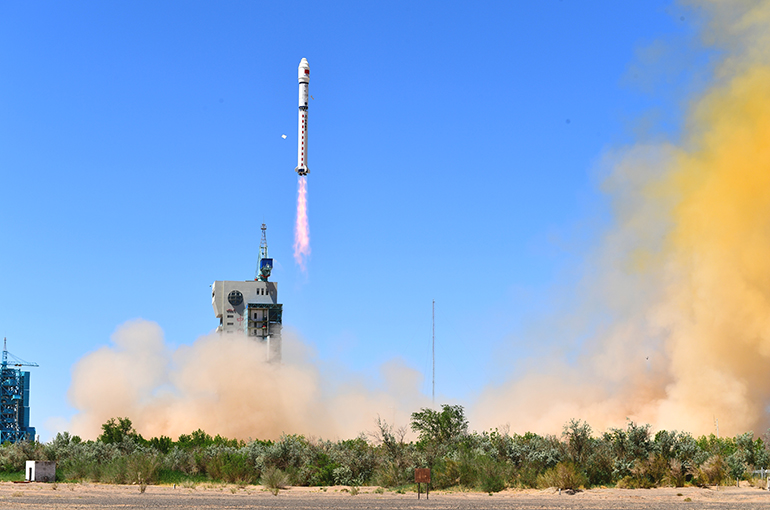
China's ADAspace is deploying a 2,800-satellite network to perform advanced AI processing directly in orbit. This system aims to bypass latency issues associated with ground infrastructure by handling massive data tasks outside of Earth. The development signals a new global race for orbital computing capabilities alongside competing plans from U.S. firms like SpaceX.

DeepSeek released its open-source V4 AI model, which features a 1 million token context window and significantly reduced operational costs. This launch directly challenges market leaders by offering high technical capacity at a lower price point, signaling an escalation in the global AI competition.
OpenAI CEO Sam Altman apologized after the Tumbler Ridge mass shooting, admitting his company failed to notify authorities about a high-risk user's AI interactions. The core issue is that internal policies did not require external reporting at the time of the incident, raising questions about current AI safety standards versus public safety mandates. This places immediate scrutiny on how large tech platforms handle dangerous content generation.

DeepSeek V4, an open-source model with a one million token context length, directly challenges US AI giants by offering highly capable alternatives at a fraction of the cost. This development significantly alters the economic landscape for enterprise buyers, providing low-cost options to compete with premium proprietary systems.
