/news/ai
Per-claim breakdown — sorted by strength
support / contradict source counts
We show our work. Read the raw research, see how we interpreted it, or skip to the finished article.
DeepSeek launched V4, a powerful new AI model optimized for Huawei chips, signaling a strategic move to reduce reliance on Western semiconductor suppliers. This development forces global tech providers to reassess infrastructure costs as open-source alternatives become more competitive against US giants.
Regional outlets framed the DeepSeek V4 launch as a direct geopolitical contest between China and the United States ¹. Conversely, trade publications emphasized DeepSeek's strategic move to decouple from Western hardware dependencies ².
The perspective of end-user enterprise developers remains absent from the current reporting cycle. These users dictate actual market adoption and integration viability, yet sources concentrate on manufacturer claims and geopolitical positioning ². Without developer input, readers cannot gauge real-world deployment friction beyond marketing assertions.
Independent AI safety auditors are also missing from this coverage. These experts are vital for assessing the inherent risks linked to a powerful model featuring distinct reasoning modes like "Think Max" ¹. The current reporting relies solely on company statements regarding these modes, leaving potential misuse unexplored.
Finally, voices from non-Chinese AI regulatory bodies are not present in the dossier. These regulators would provide context on how global standards view this technological advancement and its impact on international data governance ³. This gap limits comprehension of the international compliance landscape surrounding V4.
DeepSeek launched its DeepSeek-V4 model, featuring a 1.6 trillion parameter Pro version optimized for Huawei Ascend SuperPoD chips ¹. This integration signals a strategic maneuver by Chinese tech firms to bypass Western semiconductor restrictions while competing in the AI race.
This development pressures global AI service providers to reassess pricing and infrastructure reliance [Source: mashable.com/article/deepseek-v4-preview-comparison-chatgpt-claude-gemini]. The open-source availability of V4 lowers barriers for competitive alternatives worldwide, forcing incumbent US giants to justify premium operational costs [Source: mashable.com/article/deepseek-v4-preview-comparison-chatgpt-claude-gemini].
Outlet coverage presented a duality between technological advancement and strategic geopolitical competition ². Regional sites amplified the narrative of challenging US AI supremacy, positioning V4 as a direct contest ¹. In contrast, hardware and trade publications focused on the supply chain aspect, highlighting V4's optimization for Huawei chips ⁴.
The performance reporting reveals that the "challenge" narrative is contextually dependent on the metric emphasized by the outlet ¹. While DeepSeek asserts coding dominance, other reporting confirms US rivals maintain leads in factual accuracy and agentic capabilities ¹. This suggests the narrative of parity is selectively applied based on the metric an outlet chooses to highlight.
The open-source availability of DeepSeek V4 will accelerate competitive AI adoption globally [Source: mashable.com/article/deepseek-v4-preview-comparison-chatgpt-claude-gemini]. By releasing V4 under an MIT license, DeepSeek significantly lowers entry barriers compared to proprietary models from US firms [Source: mashable.com/article/deepseek-v4-preview-comparison-chatgpt-claude-gemini]. This economic factor forces service providers relying on high premium pricing to justify their operational expenditures against V4's stated cost efficiency [Source: mashable.com/article/deepseek-v4-preview-comparison-chatgpt-claude-gemini].
The introduction of ultra-long context windows sets a new industry benchmark for complex tasks ³. This technical leap implies a necessary shift in how enterprise AI integrators approach data ingestion and long-form reasoning workflows ³. Furthermore, AI safety auditors would likely view the 1M token window as a heightened vector for complex adversarial attacks, such as sophisticated prompt injection or data poisoning across massive inputs [Synthesis].
Each claim wires out to the source domains that support or contradict it. Click a claim for context.
Verifiability vs. source count. Lower-left is fragile; upper-right is strong consensus.
Sources arranged by stakeholder role. Distance from center grows with framing distance from this article.
Source mix
The sources cited predominantly lean towards a center-left perspective, focusing on the technological advancements and strategic moves by Chinese AI firms. The article itself adopts a balanced tone by presenting multiple facets—geopolitical rivalry, economic strategy, and analytical gaps—rather than strictly advocating for one side.
Why this alignment
The article presents a mixed view by covering both the geopolitical contest (China vs. US AI giants) and the strategic economic/technological maneuver (decoupling from Western hardware dependencies). It also critically points out missing perspectives (developers, safety auditors, non-Chinese regulators), which adds a layer of critical analysis beyond simple political alignment.
Labels are heuristic model estimates. Evaluate sources yourself.
| Source | Role | Alignment | Rationale |
|---|---|---|---|
| China’s DeepSeek rolls out a long-anticipated update of its AI model | Media / Editorial | center-left (0.9) | The NY Daily News is a general news outlet, and this report focuses on the competitive nature of AI development between China and the US. |
| DeepSeek Drops Cheaper V4 AI as Huawei Jumps In | Media / Editorial | center-left (0.95) | TechRepublic focuses on technology trends, and this article highlights DeepSeek's V4 launch coupled with Huawei chip support to intensify global competition. |
| DeepSeek-V4 launch: New 1.6T parameter model challenges US AI supremacy in coding and math | Media / Editorial | center-left (0.9) | AZ News reports on the technical capabilities of the DeepSeek V4 model and its challenge to US dominance in specific AI domains. |
| China's DeepSeek Releases Long-awaited New AI Model | Media / Editorial | center-left (0.95) | AAWSAT is a technology news source, and this piece emphasizes the cost reduction of DeepSeek's new model compared to US rivals. |
| DeepSeek unveils new AI model tailored for Huawei chips as China pushes for tech autonomy | Media / Editorial | center-left (0.95) | MSN (via Reuters) reports on the strategic aspect of DeepSeek tailoring its model for Huawei chips as part of China's broader push for technological autonomy. |
| AI Arms Race Accelerates With New Models from OpenAI, DeepSeek and Anthropic | Media / Editorial | center-left (0.9) | MSN reports on the broader trend of an 'AI Arms Race' involving multiple major players, including DeepSeek. |
| China’s DeepSeek unveils V4 AI model with 1M context window, targets US rivals | Media / Editorial | center-left (0.95) | MSN reports on the technical specifications of DeepSeek's V4 (1M context window) while framing it within the competitive context against US rivals and OpenAI's advancements. |
| Deepseek’s v4 breakthrough: chinese ai pushes efficiency and domestic chips | Media / Editorial | center-left (0.95) | Domain-B focuses on technology and this article highlights the technical optimization of DeepSeek V4 for domestic Huawei chips, emphasizing efficiency. |
| China Houses - Daz 3D | Unknown | unknown (0.1) | This source is a 3D model repository and has no discernible editorial stance or relevance to the AI topic. |
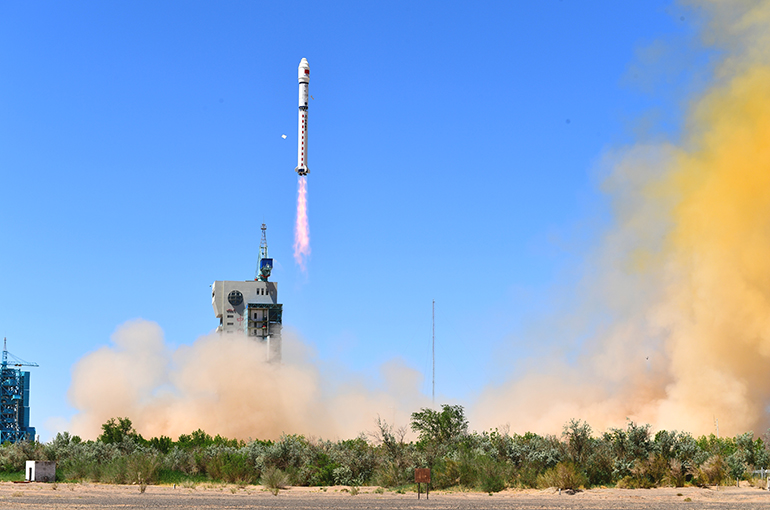
China's ADAspace is deploying a 2,800-satellite network to perform advanced AI processing directly in orbit. This system aims to bypass latency issues associated with ground infrastructure by handling massive data tasks outside of Earth. The development signals a new global race for orbital computing capabilities alongside competing plans from U.S. firms like SpaceX.
DeepSeek released its open-source V4 AI model, which features a 1 million token context window and significantly reduced operational costs. This launch directly challenges market leaders by offering high technical capacity at a lower price point, signaling an escalation in the global AI competition.
OpenAI CEO Sam Altman apologized after the Tumbler Ridge mass shooting, admitting his company failed to notify authorities about a high-risk user's AI interactions. The core issue is that internal policies did not require external reporting at the time of the incident, raising questions about current AI safety standards versus public safety mandates. This places immediate scrutiny on how large tech platforms handle dangerous content generation.
DeepSeek V4, an open-source model with a one million token context length, directly challenges US AI giants by offering highly capable alternatives at a fraction of the cost. This development significantly alters the economic landscape for enterprise buyers, providing low-cost options to compete with premium proprietary systems.
