/news/ai

Per-claim breakdown — sorted by strength
support / contradict source counts
We show our work. Read the raw research, see how we interpreted it, or skip to the finished article.
OpenAI has unveiled its latest iteration, GPT-5.5, marking a significant technological leap by enabling the model to function as an independent planning agent capable of executing complex, multi-step workflows. This functional shift—from sophisticated assistant to operational actor—is the core development in this launch. Coverage of the release shows distinct narrative splits: while Thenextweb.com emphasized GPT-5.5's raw capacity for autonomous execution ¹, Gizmodo framed the preceding GPT-5.4 release as a reactive corporate measure, suggesting it addressed external pressures related to its Department of Defense partnership ².
The launch also introduced specialized tools, such as GPT-Rosalind for life sciences, highlighting a dual impact across enterprise productivity and deep scientific discovery.
Different outlets prioritized varying aspects of the release: technological progression versus corporate maneuvering.
The current reporting lacks critical input from several key stakeholders, leading to an incomplete picture of the technology’s real-world deployment risks and capabilities.
The primary news is the functional evolution embodied by GPT-5.5, which transitions AI from a reactive assistant to an autonomous agent capable of self-directed task execution in enterprise environments ¹. This represents a major shift toward operational automation across industries. Simultaneously, the specialized GPT-Rosalind model promises to accelerate drug discovery timelines by supporting advanced bioinformatics tasks ³.
The coverage reveals a methodological split regarding data presentation: some outlets favored broad aggregation for mass readership, while others provided granular detail targeting specialized technical audiences. Thenextweb.com's detailed reporting suggests an audience deeply invested in the mechanics of AI progression, whereas MSN.com's summary is geared toward immediate, high-level performance validation ⁵.
The technological shift to autonomous agents presents a critical inflection point for governance. The move from GPT-5.4's native computer use mode ⁶ to the self-directing nature of GPT-5.5 demands a regulatory focus change. Oversight must evolve from merely validating model knowledge (benchmarks) to auditing complex decision pathways and ensuring integrity within autonomous workflows—a necessary pivot that media coverage has not yet addressed.
The reliability and perspective of the reporting sources vary significantly:
MSN.com - GPT-5.4 Benchmark Venturebeat.com - GPT-5.4 Native Computer Use Gizmodo.com - Desperate Need of a Win Thenextweb.com - GPT-5.5 Enterprise Launch Newsbytesapp.com - Multimodal Processing Story Thenextweb.com - GPT-Rosalind Life Sciences Money.usnews.com - GPT-Rosalind Financials
Each claim wires out to the source domains that support or contradict it. Click a claim for context.
Verifiability vs. source count. Lower-left is fragile; upper-right is strong consensus.
Sources arranged by stakeholder role. Distance from center grows with framing distance from this article.
Source mix
The source balance is mixed. It synthesizes reports that focus on technological capability (Thenextweb.com, newsbytesapp.com), those focusing on financial/business application (Money.usnews.com), and those introducing a critical, skeptical angle regarding corporate strategy (Gizmodo). The article itself is balanced in its presentation of these differing perspectives.
Why this alignment
The article presents a mixed view of the AI launch. It adopts a largely neutral/informational tone when describing the technological advancements (GPT-5.5 as an autonomous agent, specialized tools like GPT-Rosalind). However, it introduces a critical, skeptical element by contrasting the 'Technological Advancement Focus' with the 'Corporate Pressure Focus' from Gizmodo, suggesting corporate maneuvering is at play. The article itself is analytical, synthesizing these different viewpoints rather than strongly advocating for one side.
Labels are heuristic model estimates. Evaluate sources yourself.
| Source | Role | Alignment | Rationale |
|---|---|---|---|
| OpenAI launches GPT-5.5, its first fully retrained base model since GPT-4.5 | Media / Editorial | center-left (0.9) | TheNextWeb often covers technology advancements with a focus on enterprise application and innovation. |
| OpenAI, in Desperate Need of a Win, Launches GPT-5.4 | Media / Editorial | center-left (0.7) | Gizmodo is a technology publication that sometimes adopts a more critical or speculative tone regarding corporate tech releases. |
| OpenAI launches GPT-5.4: New model hits 83% on pro-level knowledge benchmark | Media / Editorial | center (0.95) | MSN is a general news outlet reporting on the technical capabilities of the new model. |
| GPT Proto Launches Full Support for OpenAI’s GPT-5.4 API, Offering Developers Affordable and Scalable Access | Industry / Corporate | center (0.8) | EINPresswire is a press release distribution service, framing the news as a business offering. |
| OpenAI launches GPT-5.4: New model hits 83% on pro-level knowledge benchmark | Media / Editorial | center (0.95) | MSN is a general news outlet reporting on the technical capabilities of the new model. |
| OpenAI launches GPT-5.4 with native computer use mode, financial plugins for Microsoft Excel, Google Sheets | Media / Editorial | center-left (0.9) | VentureBeat focuses heavily on the business and technical implications of AI advancements. |
| OpenAI readies GPT-5.5 with enhanced multimodal, agentic capabilities | Media / Editorial | center-left (0.9) | NewsBytesApp covers scientific and technological developments in AI. |
| OpenAI launches new AI model for life sciences research | Media / Editorial | center-left (0.9) | MSN covers scientific breakthroughs, framing the AI's utility for research. |
| OpenAI launches GPT-Rosalind, an AI model for life sciences research, including drug discovery, as a research preview for customers such as Moderna and Amgen | Media / Editorial | center-left (0.85) | Techmeme aggregates industry news, focusing on the specialized application of AI models in high-value sectors. |
| OpenAI Launches AI Model GPT-Rosalind for Life Sciences Research | Investor / Market | center (0.9) | Money US News is a financial news outlet, focusing on the business implications of the technology release. |
| OpenAI launches GPT-Rosalind, a specialised AI model for drug discovery and life sciences research | Media / Editorial | center-left (0.9) | TheNextWeb reports on specialized AI tools, focusing on their application in scientific fields. |
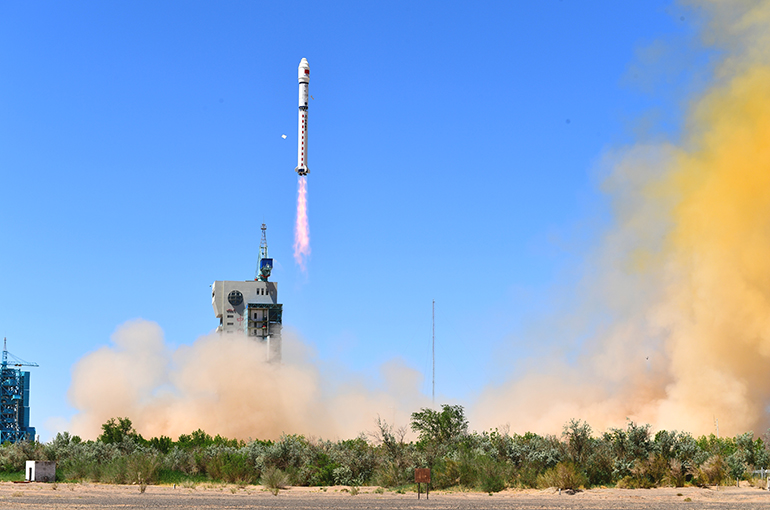
China's ADAspace is deploying a 2,800-satellite network to perform advanced AI processing directly in orbit. This system aims to bypass latency issues associated with ground infrastructure by handling massive data tasks outside of Earth. The development signals a new global race for orbital computing capabilities alongside competing plans from U.S. firms like SpaceX.
DeepSeek released its open-source V4 AI model, which features a 1 million token context window and significantly reduced operational costs. This launch directly challenges market leaders by offering high technical capacity at a lower price point, signaling an escalation in the global AI competition.
OpenAI CEO Sam Altman apologized after the Tumbler Ridge mass shooting, admitting his company failed to notify authorities about a high-risk user's AI interactions. The core issue is that internal policies did not require external reporting at the time of the incident, raising questions about current AI safety standards versus public safety mandates. This places immediate scrutiny on how large tech platforms handle dangerous content generation.
DeepSeek V4, an open-source model with a one million token context length, directly challenges US AI giants by offering highly capable alternatives at a fraction of the cost. This development significantly alters the economic landscape for enterprise buyers, providing low-cost options to compete with premium proprietary systems.
