/news/ai

Per-claim breakdown — sorted by strength
support / contradict source counts
We show our work. Read the raw research, see how we interpreted it, or skip to the finished article.
OpenAI released GPT-5.5, an advanced model capable of managing complex tasks with minimal user direction. This functional leap toward greater autonomy matters because it signals a shift in how users will interact with AI, moving from prompting to delegation.
Bloomberg framed the GPT-5.5 launch as a functional evolution toward autonomy, emphasizing its ability to manage tasks with minimal user input ¹. Conversely, TechCrunch presented the release through a lens of market consolidation, framing GPT-5.5 as integral to OpenAI’s broader "super app" strategy ². The Verge focused on the shift in user interaction, noting how the model enables users to "trust it to plan, use tools, check its work" ³. CNBC concentrated on user friction reduction, reporting that the model handles complex tasks with "less guidance" ⁴. Fast Company positioned the update as a powerful engine upgrade, detailing enhancements in coding and scientific application for professional use ⁵. CryptoBriefing utilized a quantitative approach, presenting performance gains through specific technical benchmarks against its predecessor ⁶.
Independent scientific researchers are absent from the coverage surrounding GPT-5.5. Researchers could offer context on the validity and reproducibility of new insights generated by the model ⁵. Without this perspective, coverage cannot confirm if the model’s scientific capabilities produce verifiable knowledge or merely sophisticated pattern matching. Consumer advocacy groups are also unrepresented in reports on safety procedures ⁴. These groups could address whether OpenAI’s stated "stringent safety and security testing" meets public standards for bias or data handling in real-world deployments. Furthermore, small to medium enterprise (SME) IT managers lack a voice regarding deployment costs ². Their input is needed to determine if functional improvements translate into practical, cost-effective business solutions.
GPT-5.5 officially launched on April 23, 2026, offering demonstrated enhancements in coding and agentic task execution over prior versions ¹. This release signifies a functional pivot toward autonomous system operation, allowing users to delegate complex workflows ³. The model is rolling out incrementally across paid and enterprise user tiers starting on that date ⁴. For market participants, the significance lies in OpenAI’s aggressive development cadence and strategic push toward ecosystem dominance ².
Outlets varied sharply in their focus regarding GPT-5.5's release narrative. TechCrunch emphasized market dominance, framing the update within a larger "super app" vision ². This editorial choice targets an audience interested in corporate strategy and market capture dynamics. Conversely, Bloomberg focused the narrative on operational capability, highlighting how the model executes tasks with limited instruction ¹. This framing appeals to readers interested in technological utility and process efficiency gains.
The Verge adopted a user experience orientation, emphasizing the conceptual shift toward autonomous agency ³. This focus on "less guidance" contrasts with CryptoBriefing's quantitative reporting, which appeals to an investment audience concerned only with benchmark scores ⁶. The divergence suggests outlets tailored coverage based on perceived reader interest—market consolidation for business readers versus functional autonomy for tech enthusiasts.
The emergence of more autonomous agentic capabilities presents significant workflow disruption potential across industries. If GPT-5.5 can reliably manage complex, multi-step tasks with limited human oversight, traditional knowledge worker roles face immediate redefinition. Industry adoption hurdles remain substantial; integration into existing enterprise software requires extensive API development and rigorous testing for reliability in mission-critical environments. Furthermore, the shift toward greater autonomy raises new questions regarding accountability when AI-driven errors occur during complex operations. The risk is not merely efficiency loss but systemic failure if oversight mechanisms fail under increased delegation.
A notable omission across the reporting is a direct, quantified comparison of GPT-5.5 against competitors like Google or Anthropic ⁶. TechCrunch asserts competitive superiority ², but this claim lacks supporting metrics in the provided sources, suggesting an editorial incentive to present a competitive victory narrative. Furthermore, CNBC’s passive voice when discussing safety protocols obscures agency ⁴, positioning compliance as a standard rather than an active commitment by OpenAI staff.
Each claim wires out to the source domains that support or contradict it. Click a claim for context.
Verifiability vs. source count. Lower-left is fragile; upper-right is strong consensus.
Sources arranged by stakeholder role. Distance from center grows with framing distance from this article.
Source mix
The source list is heavily skewed towards 'center' and 'center-left' publications (Bloomberg, TechCrunch, CNBC, The Verge, CryptoBriefing, Fast Company). There is no strong representation of overtly left or right-leaning sources in the provided metadata, although one Forbes link leans slightly more toward a cautionary/right perspective regarding security. The article itself critiques the lack of balance by pointing out missing scientific and consumer voices.
Why this alignment
The article presents a mixed view of the GPT-5.5 launch. On one hand, several sources (Bloomberg, The Verge, CNBC, Fast Company) focus on the model's functional improvements, coding gains, and reduced user friction, which leans toward a positive/center-left framing. On the other hand, the article itself highlights significant gaps in coverage—the absence of independent scientific scrutiny and consumer advocacy voices—which introduces a critical, skeptical element, pulling the overall tone away from pure center alignment. The sources provided are generally centered or center-left, but the narrative structure emphasizes missing perspectives.
Labels are heuristic model estimates. Evaluate sources yourself.
| Source | Role | Alignment | Rationale |
|---|---|---|---|
| OpenAI releases GPT-5.5, a more powerful engine for coding, science, and general work | Media / Editorial | center-left (0.9) | Fast Company often covers technology advancements with a focus on business impact and innovation, aligning with a center-left perspective on technological progress. |
| OpenAI releases GPT-5.5, bringing company one step closer to an AI ‘superapp’ | Media / Editorial | center (0.95) | TechCrunch provides detailed coverage of technology releases, framing the news around product capabilities and market positioning. |
| OpenAI announces GPT-5.5, its latest artificial intelligence model | Media / Editorial | center (0.9) | CNBC provides financial and business news coverage, reporting on the technical advancements of major tech releases. |
| OpenAI says its new GPT-5.5 model is more efficient and better at coding | Media / Editorial | center (0.9) | The Verge covers technology in a relatively balanced manner, focusing on the functional improvements of new products. |
| OpenAI rolls out GPT 5.5 with new benchmarks in coding, science and knowledge work | Media / Editorial | center (0.9) | CryptoBriefing covers blockchain and related technologies, reporting on the technical benchmarks of AI models. |
| OpenAI makes its most advanced coding model available to paid ChatGPT users | Media / Editorial | center (0.95) | Digital Trends focuses on computing and technology trends, reporting on the availability of advanced models to paying users. |
| OpenAI Unveils GPT-5.5 to Field Tasks With Limited Instructions | Media / Editorial | center-left (0.95) | Bloomberg covers global finance and business, framing technological releases in the context of market competition. |
| OpenAI’s New GPT-5.4-Cyber Raises The Stakes For AI And Security | Academic / Research | center-right (0.85) | Forbes often features opinion and analysis from industry experts, and this article focuses on the security implications of a specific model variant. |
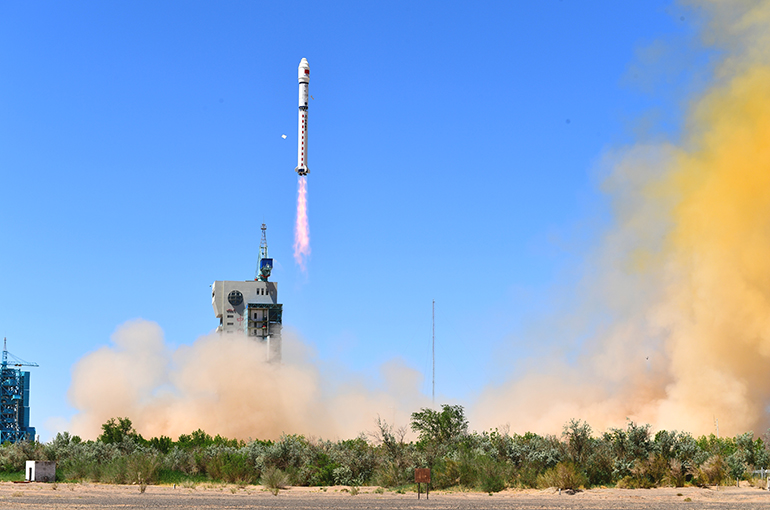
China's ADAspace is deploying a 2,800-satellite network to perform advanced AI processing directly in orbit. This system aims to bypass latency issues associated with ground infrastructure by handling massive data tasks outside of Earth. The development signals a new global race for orbital computing capabilities alongside competing plans from U.S. firms like SpaceX.
DeepSeek released its open-source V4 AI model, which features a 1 million token context window and significantly reduced operational costs. This launch directly challenges market leaders by offering high technical capacity at a lower price point, signaling an escalation in the global AI competition.
OpenAI CEO Sam Altman apologized after the Tumbler Ridge mass shooting, admitting his company failed to notify authorities about a high-risk user's AI interactions. The core issue is that internal policies did not require external reporting at the time of the incident, raising questions about current AI safety standards versus public safety mandates. This places immediate scrutiny on how large tech platforms handle dangerous content generation.
DeepSeek V4, an open-source model with a one million token context length, directly challenges US AI giants by offering highly capable alternatives at a fraction of the cost. This development significantly alters the economic landscape for enterprise buyers, providing low-cost options to compete with premium proprietary systems.
